Embracing Trying Things: The Secret to Growth and Creative Discovery
In a world that often demands specialization and certainty, the simple act of Trying Things has become a powerful antidote to stagnation. Whether you are a professional looking to pivot in your career, a hobbyist searching for a new outlet, or a designer seeking the perfect aesthetic touch, the willingness to experiment is the engine of progress. We often hesitate to try new endeavors because of the fear of failure or the unknown, yet it is precisely within these experiments that we find our greatest breakthroughs. By adopting a mindset focused on exploration, you unlock potential that rigid planning can never reach.
The Philosophy of Exploration
At its core, Trying Things is about shedding the pressure of perfection. It is a commitment to curiosity over competence in the initial stages. When we allow ourselves to dabble, we create a low-stakes environment where creativity can flourish. This approach is particularly vital in creative industries and personal development. Instead of waiting for the "perfect" time or the "perfect" skill set, you begin with action. This philosophy suggests that experience is the best teacher and that the only true failure is the refusal to engage with the new.
For many, the challenge lies in the overwhelming number of choices available today. From digital tools to artistic mediums, the sheer volume of options can lead to paralysis. However, when you frame the process as Trying Things, the pressure dissolves. You are not committing to a lifelong path; you are merely testing the waters. This psychological shift is crucial for overcoming the inertia that keeps us stuck in our comfort zones.
Finding Your Aesthetic: A Case Study in Typography
One of the most tangible ways to apply the concept of Trying Things is through visual design. Consider the search for the perfect typeface. A font is not merely a collection of letters; it is the voice of your brand or project. You might spend hours scrolling through catalogs, unsure of what works. This is where experimentation pays off.
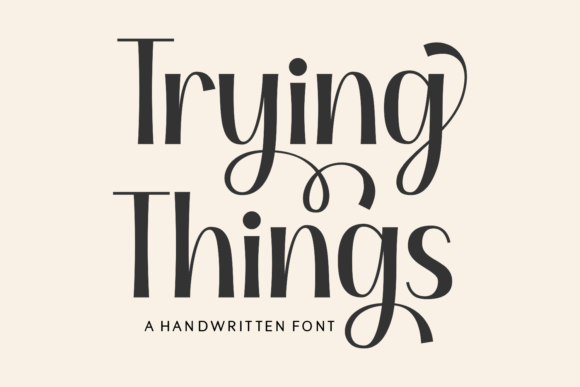
Imagine you are working on a wedding invitation or a heartfelt thank-you card. You need something that conveys warmth, but also sophistication. You might stumble upon a typeface that feels equally charming and elegant. This font looks stunning on wedding invitations, thank you cards, quotes, greeting cards, logos, business cards, and every other design which needs a handwritten touch. By simply Trying Things—downloading a sample and applying it to your draft—you discover a tool that elevates your entire project. It is also PUA encoded which means you can access all of the glyphs and swashes with ease, allowing for further customization without technical hurdles.
Practical Applications in Daily Life
The utility of Trying Things extends far beyond graphic design. It is a strategy applicable to every facet of life.
- Career Development: Professionals who try new skills, even those outside their immediate job description, often find unexpected synergies. Learning a bit of coding, trying public speaking, or experimenting with project management can open doors to promotions or new career paths.
- Wellness and Health: Finding the right exercise routine or diet is rarely a one-size-fits-all solution. It requires Trying Things. You might hate yoga but love kickboxing. You might dislike meditation but find peace in gardening. The key is to sample until you find what resonates.
- Home Improvement: Interior design is an iterative process. Trying a bold paint color, rearranging furniture, or experimenting with lighting can transform a living space. The willingness to undo a change is part of the process.
Overcoming the Fear of Failure
The primary barrier to Trying Things is the fear that the effort will be wasted if the outcome is negative. This is a misconception. In the realm of experimentation, there is no negative outcome, only data. If you try a new recipe and it tastes bad, you have learned what not to do next time. If you attempt a new business strategy and it fails, you have gained insight into the market.
Reframing failure as feedback is essential. When you view each attempt as a data point rather than a judgment on your ability, you liberate yourself to continue experimenting. This resilience is what separates those who grow from those who remain static. Trying Things builds a muscle for adaptability, which is perhaps the most valuable skill in a rapidly changing world.
Tailoring the Approach to Different Users
Different personality types approach the act of Trying Things differently, and understanding your own style can help you implement it more effectively.
The Planner
If you are a natural planner, unstructured experimentation can feel chaotic. To incorporate Trying Things, schedule it. Dedicate a specific hour each week to "exploration time." Treat it as a meeting with yourself where you are allowed to browse, tinker, or learn without a specific deliverable. This structure makes the chaos of experimentation feel safe and manageable.
The Impulsive Doer
If you tend to jump in headfirst, your challenge might be staying with a new thing long enough to understand it. For you, Trying Things needs a slight leash. Commit to a short-term trial period—perhaps 30 days—before deciding to quit or continue. This ensures you give the new experience a fair chance before moving on to the next shiny object.
The Skeptic
For those who are risk-averse, start with low-investment trials. Use free trials for software, borrow equipment instead of buying it, or shadow someone in a role you are curious about. The goal is to lower the barrier to entry so that Trying Things doesn't feel like a financial or emotional gamble.
Implementation and Actionable Steps
To truly benefit from this philosophy, you must move from reading about it to doing it. Here is a simple framework for implementation:
- Identify an Area of Curiosity: Pick one domain where you feel stuck or bored. It could be a hobby, a professional skill, or even a daily routine.
- Define the "Thing": Be specific. Instead of "learn to draw," try "draw one portrait using charcoal." Specificity makes the task less daunting.
- Set a Time Limit: Give yourself a defined window to try this thing. It could be an afternoon or a month.
- Reflect: After the time is up, assess. Did you enjoy it? Did you learn something? Would you continue?
By following these steps, you turn the abstract concept of Trying Things into a concrete practice. You begin to build a life rich with experience and variety, rather than one dictated by routine.
The Outcome of a Life Well-Tried
Ultimately, the goal of Trying Things is not to become a master of everything, but to live a more engaged and fulfilling life. It is about discovering hidden talents, finding tools that make your life easier—like that perfect elegant font for your business cards—and building confidence in your ability to navigate the unknown. When you embrace the habit of trying, you stop waiting for life to happen to you and start actively participating in its creation. The journey of a thousand miles begins with a single step, and the journey of a thousand skills begins with a single attempt.